August 12, 2017 Zurich Switzerland to Luzern Switzerland to Breisach Germany

In Switzerland politicians are not idolized and people don’t exaggerate their importance either to do good, or do bad. Americans and Canadians could learn from the Swizz. The people elect 220 members of the Assembly who in turn elect the Ministers. That is sort of like Canada. The members of the Assembly also elect the President. With a system like that no one makes a big deal about who the President is. It really does not matter that much. One of the things that our tour leader said I found most interesting. She said that many people in Switzerland do not know who their current President is. I think that is cool and a good sign of a healthy democracy.

Swiss independence was recognized in 1648 during the Treaty of Westphalia that ended the bloody 30 Years War, caused by religious differences that got out of hand. The country is formally neutral, but it is armed. Our tour leader explained that recently the government debated whether or not it should  invest in new fighter jets at a cost of billions. Eventually it decided that it did not make sense to buy jets that could travel right across the country in 6 minutes! Wow, how sensible can you get?


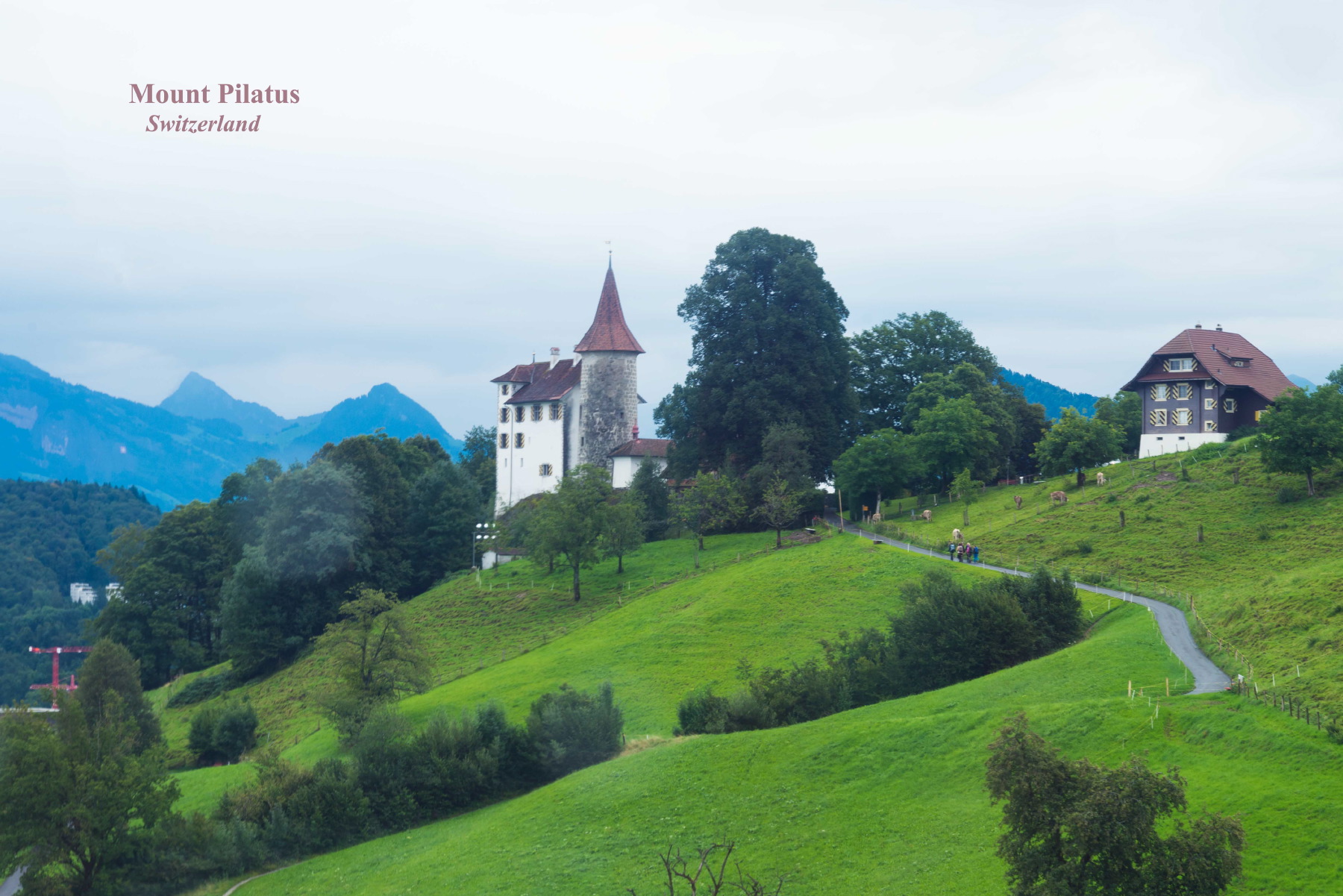
Our first destination today was Mount Pilatus–a mountain that rises 6,981 feet. From the gondola we took to the summit we had glorious views of the mountain. Below we could see hikers, coniferous trees, cows (with bells) and numerous varieties of wild flowers. For a flower child like me, it was very difficult not to spend all my time there. I would love to hike it some day. Perhaps when I am not so old. To get down the mountain again we took a cogwheel train

The ride on the cogwheel train is amazing. The cogwheel train that we took down the mountain was incredibly steep. Apparently it drove down at 48° at some points. I wish I could have seen that from the outside. From inside the rail car it is not easy to see.

When we got down to the bottom of the mountain we got back on our coach and drove along the Lake of the 4 Cantons to Luzern. I really think the city centre is one of the most beautiful in Europe. Chris to my disappointment was not quite as enamoured of it as I was.


I think that Luzern is one of the great cities of Europe. Mark Twain was in my camp. He thought that when he visited Luzern in 1878 that he had found a place of enchantment. He loved the way the town “scrambles up and spreads itself over two or three hills in a crowded, disorderly, but picturesque way.” I love disorderly and picturesque. Crowded not so much.


I have been told that Luzern has not changed that much from 1878. It does have a stunning combination of a romantic city set in lovely mountains. There was magnificent beauty to be found here. One only had to look around the tourists. I think it is one of the most beautiful city centres I have ever seen. The old buildings, bridges and churches were stunning.

A highlight was, of course, the ancient bridge called Kapellbrücke with Wasserturm. This is an outstanding feature of this sparkling city. It is a wooden bridge that stretches more than 660 feet long on stilts over the River Reuss.

Luzern has a strong claim to civilization. Its magnificent preservation of history is powerful evidence to support its claim. It likes to be considered the ‘City of Music.” If that is true it is truly civilized. Music is certainly one of the important markers of a civilized society. The city refers to itself as a city of festivals throughout the year.


The Hapsburgs purchased the town (how do you purchase towns?) in 1291 from the owner of the town Murbach Abbey in Alsace. In 1332 Luzern joined the Swiss Confederation. The people of Luzern were not always enamoured of their Hapsburg “owners.” In 1386 they were so unhappy with the Hapsburgs that they won their freedom in the Battle of Sempach. After the Protestant Reformation in the 16th century Luzern became a Catholic of the Counter -Reformation challenging the Protestants.

Near the end of our walk we encountered a loud group of boisterous marching young men banging drums and shouting incomprehensibly. It looked like the revolution had begun. We wondered if this was a political group protesting an injustice or a soccer team celebrating their own greatness. Soon we realized it was the latter. While we were glad to be safe, we were sorry to have missed out on history. As I have always said, “Start the revolution without me.” I will join later—when its safe.

Our walk was pitifully short for such a wonderful place, but is one of the hazards of travel. Good things are of too short a duration; pain last interminably. Too soon we were herded back into our coaches to continue our journey. Everything led to the ship.

In Basel we moved in to our Riverboat Imagery II operated by Avalon. We loved the ship. We particularly loved the large open windows that in effect made the entire cabin a balcony. We had been “sold” on this in Canada but were a bit sceptical that it would work. It worked wonderfully. The best things on the ship though were outstanding food, copious amounts of wine or beer served with meals, and the amazing group of friends that we made.

After we checked in with front desk we went directly to the bar without passing go. Chris had a Jameson and I had dark rum. This was a start of things to come. Frankly, and I must tell the truth in the chronicles, no matter how scurrilous that truth is, on this trip we drank too much. Part of the problem was the many good friends we made on this trip. My mother always said that I was a very nice boy but bad associates were leading me astray. I have always agreed with this unbiased assessment.


August 11, 2017 Zurich

August 11, 2017 Zurich, Switzerland—Where beer and wine are as cheap as water

Today, we took a half-day city tour by coach. Most of the buildings in Zürich were built in the 19th century and that was exactly the time I was reading about in my Hobsbawm book—The Age of Capital—so I appreciated that. It is a 1 in a series of 4 books on European history since the French Revolution. I loved that book for it had insights on every page. I find a book like that adds immeasurably to travel.
Zürich has one of the best and most used public transportion systems in the world even though it is about half the size of Winnipeg. And it worked marvelously well.
Public transportation is extremely popular in the city. About 70% of the visitors to the city use it as we did today. About 50% of all journeys in the city are taken on the public transportation system. That is among the densest usage in the world.
Logically, in my opinion, the people prefer to travel by train or bus. Who wouldn’t? Really you would be stupid if you did not use it. It was that good. Residents of Zürich are not as enamoured of private vehicles as we North Americans are. Zürich train station is the busiest train station in the world!
We stopped to take a photograph of Lake Zürich but really we were not that impressed. The lake is nice, but not really anything special. Our guide said that the water from the lake is drinkable. Why then, we wondered, do so many people drink bottled water in Zürich? Of course, I wonder that about most cities. I wonder about that back home too.
We drove by the University of Zürich, which is home to 26,000 students. A sign of respect that the country gives to education is seen in the fact that every University student is given a free pass for the public transportation system. That is perhaps why it has had 21 Nobel Prize winners. Compare that to Canada which has a population nearly 4 times as high, but it has had 22 Nobel Prize winners–only 1 more. And of Canada’s winners, one was Saul Bellow who was born in Canada but spent most of his life in the United States. I would call him more of an American Nobel winner than Canadian winner.
As our guide pointed out Zürich benefits from the fact that its citizenry is very educated. I believe that this is true, even though neo-liberals don’t see it. Having an educated public was instrumental in Zürich attracting substantial business from Google. Corporations like more things than low taxes. I don’t deny that low taxes are attractive to businesses, but they are by no means their only concern when deciding where to start a business.
Zürich has been an intellectual centre for more than a century. Many famous intellectuals have lived and worked hear such as Lenin, Einstein, Le Corbusier, Jean-Luc Godard, Daniel Bernoulli, Jean-Jacques Rousseau, Carl Jung, Elizabeth Kübler-Ross, and Napoleon III. That is a pretty impressive line-up for a city much smaller than Winnipeg.
It is my belief that education and respect for knowledge has played an important role in making the Swiss happy. That might sound funny. Most people don’t associate school with happiness. Switzerland is consistently voted one of the best (if not the best) places in the world to live. Switzerland was ranked No. 1 in the world’s happiest countries in the world in 2015 and came in second in 2016, after Denmark, out of 156 countries. Even though their society, as we learned is far from perfect, we have a lot to learn from the Swiss.

001-Grossmunster-Church--1.jpg
Zürich has 3 old and famous churches. The oldest is Grossmünster (Great Minster) Church. According to legend, Holy Roman Emperor Charlemagne started construction around 1100 more than 900 years ago. That was 400 years before Columbus “discovered” North America on behalf of Europeans.
Kenneth Clark said that the hallmark of civilization is the desire to create something that lasts. If that is a valid comment, and I believe it is, then this is certainly part of Western civilization–an important part of civilization.


003-Fraumunster-Church-1
The next church we marveled at was Fraumünster Church. This church was a former abbey for aristocratic women from southern Germany that was founded in 853 by Louis the German for his daughter Hildegard. The first church was built before 874 but not the current church on the same site.
The third church we saw was St. Peter church that was built on the remains of former churches at the same site since before the 9th century A.D. That makes it pretty old too. It also has the largest clock face in Europe. The clock was built in 1538. Think about that. The clock has been operating since 1538 about the time that Jacques Cartier and his crew was exploring Canada as the first European explorers to do so and that clock is still working!
At the hotel we discovered that wine and beer were as “cheap” as water. Of course a bottle of water cost about $10. Hardly cheap. That same bottle of water in the Train station store cost less 85 cents! Beer too was about the same as a bottle of water. Have I arrived in paradise where beer is cheaper than water?

August 10, 2017 Zurich

Today after a brief nap to try to recover from jet lag,  we explored our hotel. It is called Mővenpick Zurich Airport. We quickly realized that we could not eat in our hotel. Food was too expensive. At the restaurant in our hotel a burger and fries cost 26 Swiss Francs. That is about $45! So we had a choice–bankruptcy or starvation. After a short huddle to consider those options we settled on bankruptcy. That appeared more attractive, because it takes a while to suffer the consequence of profligate spending. Starvation happens much fast. In lieu of pending financial ruin we want to warn all of our many friends to dig deep to help us out.

We basically stayed close to the hotel because we were too tired to do much. It was also gray and rainy. So we had little appetite for exploring the city today. We had plain run out of gas as a result of out grueling flight. Being wedged into a tiny seat without sleep is just hard. I went to sleep at 8 p.m. because I could not stay awake any longer. I really did not want to go to bed that early but frankly had no choice.

Fantasyland for Real

Fantasyland for Real


I listened to a short but fascinating interview  conducted by the tireless Charlie Rose on PBS. He interviewed someone I had never heard of before. His name is Kurt Anderson. He was flogging a book he has just written that is only being published next month called Fantasyland: How America Went Haywire–A 500-year History. I must buy the book

Anderson talked about modern America and how it got to be as it is–whacky. That is my word, not his. He laid some of the blame for the bad state of America on religion. Religion and the blue smoke and mirrors of American business. America was always a country of big dreamers and true believers in the fanciful and dubious. That gullibility was always combined with practically, pragmatism, and Yankee clarity, said Anderson. This is an interesting combination.

According to Anderson things started to go seriously wrong in the 1960s. That was my time. The time of music, love and flower children. It was also the time when everyone was permitted to find their own truth and create their own reality. People were not allowed to be judgmental however. Everything was permitted. Everything was permitted except judgmentalism.

Anderson claimed that these ideas of the 1960s came from academia and New Left. Yet interestingly, these ideas empowered the far right! This kind of thinking permeated America from top to bottom. It was dangerous because “it allowed preposterous thinking all over the map,”[1] said Anderson.

Contrary to such thinking Anderson recommended we think like Patrick Moynihan who famously said, “You are entitled to your own opinion, but you are not entitled to your own facts.”

Anderson admitted there was probably no going back to the days of Moynihan. It is too late. In fact, Anderson acknowledged that there might not be any light at the end of this tunnel. He, at least, saw no hopeful end. Instead we now live in the age of Donald Trump. This is very different from the time of Moynihan. Trump in effect says that anything that is inconvenient to me or that I disagree with is, fake news. Don’t trust any “truth” you don’t believe in. That is dangerous thinking especially for a person who gets to appoint the leader of the CIA, or uses intelligence sources to determine what to do with the most powerful armed forces with the most awesome weaponry imaginable. That is outright scary. If there are no objective standards for truth we are dangerously bereft.

Since the 1960s the relativist position had become deeply embedded in American society. This attitude that there is no objective truth has seeped into a large portion of American thinking. As Anderson stated, “it is part of the American operating system.”[2]

Later with the advent of the Internet Anderson believes things got even worse. “The Internet gave the alternative fact universe its infrastructure.”[3]

Part of the problem, says Anderson, is that the Internet through its search engines “rewards the excitingly false.”[4] Wild conspiracy theories are just one example among many. “Like religion it is exciting to think that there is a puppet master out there pulling strings.”[5]

The Internet, like conspiracy theories, distorts.  That  makes the world seem simpler than it is. Anderson state, “Conspiracy theories make a tidy fiction in the way that reality is not tidy.”[6]

Donald Trump is of course the person who has taken massive advantage of the Internet. He has manipulated it. Anti-elite thinking and anti-establishment thinking has always been a part of America, Anderson said. It is not new. But Anderson believed that in the 1960s it got out of control like never before and America has never recovered. Rebels are good but they can go too far.

An interesting thing about Trump, Anderson said, is that he learned after studying him for many years, long before he became a big player in American Presidential politics, is that he has never met anyone who craves attention like Donald Trump. “Donald Trump needs attention like a drug addict needs drugs.”[7] And now he has the attention of the public in spades. In fact, Anderson pointed out, “perhaps now Trump has got more attention than anyone else in the history of the world.”[8] I hate to admit it. that is probably true.

In trying to understand America Anderson went back 500 years. He went all the way to Martin Luther. America has since the contact of Europeans been diffused with religion. According to Anderson, “America has always been exceptionally religious compared to the rest of the world.”[9] Among the first settlers to America were Puritans and others who had fled religious persecution in Europe, but they were themselves “theocratic religious nut cases.”[10] In fact, it has been said that they escaped religious persecution so that they would be free to persecute others. In any event, Americans are, as Anderson stated, “Outliers in our religiosity compared to the rest of world, not just a little bit, but a lot. We are not like the rest of the developed world, we are much more religious.”[11]

All of this, as I have been saying for some time, has serious consequences well beyond religion. Anderson put it this way, “Once as a culture you are more inclined to believe in magic, in supernatural events, it won’t stay in its religious realm. It will leach out into not believing in climate change say.” [12]

Anderson says that we are shaped by a “fantasy industrial complex.”[13] This includes not just organized religion but everything in the entertainment industry. In the US, he pointed out, everything becomes entertainment. Real estate business for example, become entertainment. Everything becomes part of show business. Religious leaders are show men. This fantasy industrial complex uses modern technology skillfully to convince us of dubious truths. Then the Internet comes along and compounds that effect massively. This is the age in which we live.

As a result we should not be surprised when ordinary people believe outrageous claims. Ordinary people are part of a culture that leads them to believe. When critical skills are lost and we learn to believe without evidence we turn ourselves over to fake news and the demagogues that take advantage of it.

[1] Kurt Anderson, on Charlie Rose, PBS August 7, 2017

[2] Kurt Anderson, on Charlie Rose, PBS August 7, 2017

[3] Kurt Anderson, on Charlie Rose, PBS August 7, 2017

[4] Kurt Anderson, on Charlie Rose, PBS August 7, 2017

[5] Kurt Anderson, on Charlie Rose, PBS August 7, 2017

[6] Kurt Anderson, on Charlie Rose, PBS August 7, 2017

[7] Kurt Anderson, on Charlie Rose, PBS August 7, 2017

[8] Kurt Anderson, on Charlie Rose, PBS August 7, 2017

[9] Kurt Anderson, on Charlie Rose, PBS August 7, 2017

[10] Kurt Anderson, on Charlie Rose, PBS August 7, 2017

[11] Kurt Anderson, on Charlie Rose, PBS August 7, 2017

[12] Kurt Anderson, on Charlie Rose, PBS August 7, 2017

[13] Kurt Anderson, on Charlie Rose, PBS August 7, 2017

The Gay Science

Nietzsche talked about what he called “the Gay Science.” Unfortunately that now has a new meaning. What Nietzsche meant was “a sense of joy at facing life’s absurdity or cruelty or viciousness.” “Facing the world, knowing all of its nastier points and smiling anyway,” was what Nietzsche wanted to see and do. Exercise is one way to do the, but there are others.

Nietzsche thought the body was very important. He thought dance was important. Physicality was important. The very same people who were disembodied and who were interested in an otherworldly life, an anemic life, a fleshless life, were also the people who denied the world. These other people said there was another place, a heaven. Nietzsche’s view is an embrace of the body and of our biology. “And,” according to one philosopher, who talked about running and Nietzsche, two of my favourite topics, “we are able to embrace a more joyous existence.”

“So the joy of running is not about anything, it is just a glimpse of what is to be alive,” Young said. It is to be happy for this glimpse.

Nietzsche also held the view there is something wonderful about feeling the power to do things. He called this “the will-to-power.” People often think he is talking about cruelty or vulgar domination. These people don’t understand Nietzsche. When he talks about the will-to-power he is talking about that profound joy you have when you are expressing yourself well.

When you are driving yourself hard, or in some way, living up to your fullest, then you feel power. It is power over self. The Overman, his hero, was the man who could overcome himself! Not some petty tyrant.


2017 Trip to Europe

2017 Trip to Europe


August 9, 2017 Steinbach Manitoba to Zurich Switzerland

In August of 2017, perhaps the worst time of the year to travel in Europe, we left Steinbach and headed to the airport to commence our trip by 2 flights to Europe. We had expected to  be travelling with friends who picked the Rhine cruise we have now booked but they changed their mind.  I made the mistake of picking this time of year.  Life is hard when you are stupid. I have learned that many times; yet I have learned nothing at all.

At the beginning of the year we headed to Arizona in search of civilization. Though we found signs of it, they were few and far between nearly drowned out by baying political animals. We still think it is there–somewhere, though perhaps, on life supports. Sadly, we found some ominous signs and civilization–and by that mean I mean western civilization–is badly in decline. Some might say we are witnessing the fall of western civilization.

So we are trying again. This time, we are heading right into the heart of Western civilization–Switzerland, Germany, France, Holland, and England. It does not get nearer the heart than this. This is surely where we can find great art, literature, music, philosophy, democracy, and religion.

If civilization is on a steep decline as sometimes it seems, we must be wary and alert for all signs. That is what I hope to do.

The flight to Toronto from Winnipeg was interesting. “Interesting” is never a good word to use about a fight by aircraft. As we stood in line–at the head of the line thanks to Chris’ sporting a cane–we heard small children wailing. Never a good start. First one child started to cry, then another. I feared I would start crying next. After all we were about to subject ourselves to the abattoir of modern international air travel.

The young children were even louder on the air craft. One of the children seemed to crying “Get me out of here.” A perfectly understandable reaction. I felt exactly like that too.

The aircraft was extremely loud. The noise was nearly unbearable. No wonder children were wailing. It also felt rickety. Like one would imagine a First World War airplane would feel like today. It seemed well qualified for a flight from Harv’s Air Service in Steinbach to Blumenort–no more.

When we arrived at Pearson International Airport we were famished. You know you are in Toronto when you pay $25 for a Panini, water, and fruit Smoothie. Not only was it too expensive, it was as tasteless as last week’s laundry. And just as nutritious. As soon as we were finished eating, we headed out to the next restaurant for food.

Waiting in the airport was also interesting. Each table was connected to the Internet with Tablets provided. Not for the 10 Commandments; to connect to the Internet. I must admit I preferred old fashioned technology–a good book. I was reading Eric Hobsbawm’s Age of Capital the history of Europe from 1848 to 1875. It had insights on every page.

The flight to Zurich was different again. This will sound so outlandish I fear no one will believe me, but I must report faithfully what happened. On our Air Canada flight from Toronto to Zurich the airline food was great. I know no one will believe me because the words “great” and “airline food” have never appeared in the same sentence before. But that is what it was. We loved our meal of chicken in a delightful sauce, and couscous, mixed salad and red wine.

On the flight I sat next to a Professor from Switzerland who had attended an academic conference in Toronto. The subject was risk management from the perspective of insurance companies. While that sounds excruciatingly boring, our conversation was not boring at all. I asked him if Switzerland was still maintaining its position of political neutrality. He assured me it was and that this position was very attractive to the Swiss. Some criticized the Swiss for supporting brutal dictatorships by their failure to denounce them. The Swiss do not believe that this is what they do. They point instead to the abject failure of attempts by the west to impose their system on other countries such as Afghanistan and Iraq. The history of western interventions is far from happy.

That history should lead the west to be cautious, but there is little evidence that the west has learned to rein in its hubris. At this very moment in history North Korea and the US led by Donald Trump are rattling their nuclear sabres at each other. Donald Trump said that if Korea threatened the US again it would be met with fire and fury the likes of which the world has never seen before. I know I shudder at the prospect of the US and North Korea each led by megalomaniacal leaders tangling with each other with nuclear warheads. Not a pleasant prospect.

My Swiss Professor friend also explained to me how they had a recent plebiscite or referendum on whether or not to purchase some very expensive modern jet fighters. The Swiss believe they have to defend themselves because of their maintained neutrality. Unlike Canada, they cannot rely on allies. While the jet will cost hundreds of millions of dollars a fighter jet can fly across Switzerland in 6 minutes. Does it make sense for the Swiss to spend millions on such aircraft? They decided to forgo the acquisition. I think they were wise. There are better things it can spent the money.

I watched a comedy movie tonight when the lights went out and I could no longer read my book. It was called Going in Style. A review is included under the category “Movies”. I won’t say Going in Style is the best movie. It is not even a great movie. It is however mildly entertaining and the 3 leading men and Anne Margaret as the spicy love interest for one of the codgers all bring years of experience and professional skills to their task. If, like me, you find yourself in a dark aircraft, unable to read a book, it is worth the view.