Category Archives: 2017 European River Cruise

August 17, 2017 Kőln Germany to the Netherlands: the Perils of Strong Drink

We arrived in Kőln at about midnight. I am very sorry to report that by then I was under the influence of strong drink. Too much imbibing at dinner. I was in a sorry condition. It turned out that was a big mistake, because as a result I failed to rouse myself to photograph the famous church at night from the boat. I got a very brief view of the famous cathedral as I happened to wake up from my slumber, and peeked out our window as we glided by it. It was really too late. Had I been in better condition I could have strolled down the street when we anchored for the night and captured a glorious image. I will never forgive myself.

And yet….I fortuitously woke up from my slumber for some incredible reason, and looked out our window, at the exact moment that that our ship glided past the famous Kőln Cathedral. I did not have time to set up my tripod. Besides the ship was moving and that might not have helped, but I had time for one, and only one grab shot of the magnificent cathedral at night. I captured a very blurry image of one of the finest cathedrals in Europe at night. I did not capture a sharp image, but I did capture the ghost of the cathedral or the essence of the cathedral. I got a picture of its skeletal outline or its bones or its pure essence. I love the image I captured. It was a wonder. Perhaps it was a miracle.

After breakfast we went on another walking tour with a local guide Ernst a sharp-tongued cynical German Ernst. Like all our guides, I enjoyed his commentary very much. It is great to have a local guide when you visit a new city for the first time.

This time we visited the city of Kőln (or Cologne if you prefer the English version). I always wonder why people have to change the name of cities or countries to match more closely, or at least phonetically, how they want the name to sound or look in their language. For example, why do some Europeans spell Canada as Kanada? It makes no sense. They could easily use the correct name with the correct spelling. Why not?


Before we saw the cathedral our guide showed us Gross St. Martin a prominent landmark in the city, but it is not old by European standards. The cathedral was completed in 1880 and a year later the city wall was demolished.

As we walked through Old Kőln our guide Ernst reminded us that in ancient times we would have been forced into constant vigilance that women from upper floors of buildings did not discard their garbage or dirty “water” or worse, onto us on the street below. In those days women dumped out their window onto the streets beneath what they wanted to discard even if it came, from the “night pot.”

Ernst drew our attention to the fact that most buildings in Kőln are “fake.” Forget about fake news, these were fake buildings. That is because 90% of the buildings were destroyed during the Second World War and many were replaced by similar buildings that would fit in better, it was thought, with the historical city centre. Ye they were good fakes. For example, as I said earlier I loved Gross St. Martin and was surprised to learn that it was “fake.” It was a good fake. I took a number of photographs of it, before and after I realized it was a fake.


It was very fortunate that the Kőln Cathedral was saved as a result of poor aim of Allied bombers, and some attributed this to God’s will. Why else would it have been spared? Of course, we might ask, why were all the other churches razed and not saved? Did God not like those other churches?


Like so many cities in Europe, Kőln also suffered at the hands of the Allied forces in their efforts to destroy the Nazi led government of Germany.   By the end of World War II 90% of Kőln was destroyed. Amazingly the Cathedral was largely spared.

Ernst, our guide, was pleased to demonstrate to us the incompetence of military combatants. The Allies used the cathedral in the heart of the city, as their target for bombing the city, and, naturally, that meant that it was saved, because the Allies so rarely hit their target! Everything around it except for the cathedral was completely destroyed. It was actually hit 14 times by aerial bombs, but most of them failed to explode, as so much Allied ordinance was a dud. Of course as so often happened with unexploded ordinance, years later children playing in the streets were attracted to it and it frequently exploded in their hands. The Allies They did manage to break many windows, but the structure was intact. Fortunately, locals spirited away the majestic 14th century stained glass from the church before the Nazis realized it. As a result it was spared too. Was that divine intervention? Or was it just another example of the incompetence of war and warriors? I think the latter.

A good example of a building that was not spared was Gross St. Martin. This church was completely destroyed because the Allies did not aim at it. They only aimed at the Cathedral because it was very large and very central, the Allies did not actually want to destroy it. After all, why bother to bomb a church? But it was their target.

The star attraction of Kőln is no doubt the Cathedral. It is a Roman Catholic Cathedral that acts as the seat of the Archbishop of Kőln and of the administration of the Archdiocese of Kőln. It is a world famous monument to German Catholicism and Gothic architecture. It was declared a world heritage site in 1996 and today is Germany’s number one tourist attraction visited by 20,000 people a day. We had an opportunity to visit it briefly, but declined. That was disappointing because it has been said that this cathedral has the finest interior of any church in Europe. However, we were getting tired and wanted to rest and were getting tired of crowds and wanted to avoid them. So we walked around the cathedral a bit, trying to get a good view for a photo and letting us rest a bit.

The Kőln Cathedral is the largest Gothic church in Northern Europe and has the second tallest spires. With its twin towers, it provides the largest façade of any church in the world. The choir has the largest height to width ratio of any medieval church. The medieval church builders wanted a magnificent building to house the dubious relics of the 3 Kings and to fit the place of worship of the Holy Roman Emperor. Only the grand was suitable for the Emperor.

For me traveling is learning.  Today we learned a little bit about Gothic Art. Gothic Architecture is a style of architecture that flourished in Europe during the High and Late Middle Ages. It evolved from Romanesque architecture and was succeeded by Renaissance architecture. It is a style that is most familiar as the style of the great cathedrals, abbeys, and churches of Europe. Many castles, palaces, universities, and town halls also have Gothic style. Gothic Architecture started in 12th century France and lasted up to the 16th century. At the time it was usually called Francigenum (“French work”). Its characteristics include the pointed arch, the ribbed vault that evolved from the joint vaulting of Romanesque architecture) and the flying buttress.

Although many of the great churches and cathedrals were built in this style, some much smaller buildings have embraced this style as well. The style often leads to appeals to the emotions and many of the smaller buildings are considered buildings of distinction. Many of the larger ones are listed with UNESCO as World Heritage Sites.

The Cathedral is a world famous example of Gothic art. Gothic art is fascinating. I will never forget my introduction to Gothic Art. That occurred when I watched a spectacular television series called Civilization and it was narrated by Sir Kenneth Clark an erudite commentator. Later I bought the companion book and enjoyed it immensely. It really was my personal introduction to art in particular and even, to some extent to civilization. It was from that occasion that I have developed a life-long interest in civilization. The good and the bad of civilization. It is never an unmixed blessing.

Early on in that wonderful series. Clark stood in front of a magnificent cathedral in France–Chartres. I had never heard of it before. I doubt that I had heard of Gothic art either. Clark saw that cathedral, and other Gothic Cathedral as being “an expression of the Divine Law and an aid to worship and contemplation.” He said, it certainly has this affect on me… this quality of lightness, this feeling of Divine Reason.”

According to Clarke, in Gothic architecture, “The dull mind rises to truth through that which is material.” “This was,” as Clark pointed out, “a revolutionary concept in the Middle Ages. It was the intellectual background of all the sublime works of art in the next century and in fact has remained the basis of our belief in the value of art until today.”

Clark the importance of the Gothic style of architecture, was not only the pointed arch, but the lightness of high windows–what we call the clerestory and triforium. ‘Bright,’ he says, ‘is the noble edifice that is pervaded by new light,’ and in these words anticipates all the architectural aspirations of the next two hundred years.” I love that concept, a structure, a work of art that is “pervaded by new light.” That is the magnificence of Gothic Art.

The height of Gothic art, to Clark, and I accept this, although I have not yet seen it, is the Cathedral at Chartres. Clark marvels at how it is permanent. Remember that is Clark’s benchmark of what is civilization. To the medieval man geometry was a divine activity. God was the great geometer, and this inspired the architect.

We must remember, that to the medieval thinkers geometry was the instrument to explore the mind of God. And architecture–in particular what was later called Gothic architecture–was the manifestation in materials of the mind of God. What an astounding concept. Clark said that in Gothic architecture with its vault and arch the architect “he could make stone seem weightless: the weightless expression of his spirit.” This was an astonishing achievement–to make a stone building seem spirit–i.e. to make it spiritual–part of the very mind of God. That summed up Gothic art.

In many ways, Clark sees the construction of the gothic Cathedrals of Europe as the birth of European civilization. Our intellectual energy, our contact with the great minds of Greece, our ability to move and change, our belief that God may be approached through beauty, our feeling of compassion, our sense of the unity of Christendom–all this, and much more, appeared in those hundred marvelous years in the 12th and 13th centuries.

It fascinates me that the Cathedral of Kőln stood incomplete for so long. The work was halted in 1473, leaving the south tower incomplete but crowned with a huge crane that remained in place as a landmark of the Kőln skyline for 400 years! Intermittently some work was done on the structure of the nave between the west front and eastern arm, but during the 16th century construction stopped completely. I would say, it stopped until the local regained their sense of confidence.

In the 19th century encouraged by the discovery of the original plans and with the commitment of the Protestant Prussian Court to complete the cathedral. Through civic effort that was achieved. The state actually saw this as a way to improve relations with its large component of Catholic subjects it had gained in 1815. Imagine that!

The new unified country of Germany celebrated the completion on August 14 1880, 632 years after construction had begun. It was the tallest building in the world for 4 years until those darn Americans completed the Washington Monument.

In 1996 the Kőln cathedral was placed on the UNESCO World Heritage list, but sadly, in 2004 it was placed on the World Heritage in Danger List.” In fact it was at the time the only western site in danger, because of plans for a high-rise building near by. That would have visually impacted the site that is already visually impacted by other structures in the area. Most of those other structures are ancient, but some of them were depressingly modern. It is not enough to get a building or an area listed; it must then be protected. In 2006 the building was removed from the site of endangered buildings list because the local authorities wisely decided to limit the heights of near by buildings.

During the evening we travelled 17 Km down a canal from the Rhine River that we had cruised for more than a week all the way to the city of Amsterdam. This was the end of our cruise, though we still had one more day on board and then 3 days in Paris and 3 days in London.


August 16, 2017 Mainz to Rüdesheim to Koblenz Germany Fear: Walls & Castles


Today we had breakfast with our Australian friends and were joined by an American Presbyterian Minister from Dayton Ohio who was also a lawyer. What an odd combination. He was a very interesting man.

I asked him something that has been bothering me for some time. How could evangelical Christians so overwhelmingly support Donald Trump for President no matter what he said or did? To me it seemed entirely incongruous.

He said that their entire conservative religion is based on fear. They fear hell, the devil, Muslims, crime, fear immigrants, elites, blacks and Hispanics. That is just the short list. They have many other fears. Their list of people to fear is extraordinarily long. That is why they support Trump’s idea to build a wall. They feel safe behind walls. Like people felt safe in the Middle Ages behind castle walls.

Trump told them when he was campaigning ‘Don’t worry, Trust me.” That was his message. The times are scary. Mexicans are sending us their worst people—rapists, drug dealers, and murderers. Blacks are getting uppity and dangerous. Trump’s message was simple. Don’t worry I will make you safe. I will take care of you. I will keep those scary people away from you and your home.

I will keep the American carnage away from you. The disaster in Chicago where crime flourishes in the city centre should be kept on the other side of a wall too. “Believe me,” he says and they do. They feel safe with Trump. I think they still do and that is why they continue to support him.

Americans are very fearful people. They spend more on their military than the next 8 countries combined, yet they are scared of everyone. That is why I think their civilization is in decline. Fear is inimical to the desire to build civilization. That requires confidence, something current Americans lack.

Until today we were a bit disappointed that we had not seen much of Europe from the boat. Usually we sailed at night when we could see nothing. So really we felt the idyllic scenes of sailing by castles on the Rhine were a bit deceiving. That is we felt like that until today. Today things were different. We sailed right by the castles. Before the day was finished my camera was nearly white hot from taking over 500 images. Before the day was out we were nearly ready to cry out, “ABC.” That meant, “Another bloody castle.” I must admit I never felt like yelling out ‘ABC.’ Today we spent the entire day on the ship. In morning we had it nearly to ourselves as skipped an excursion. It felt like this was our personal yacht.

Castles were built because rich Europeans (no one else could afford a caste) feared many things too. They feared invasion, the princes nearby, foreign nobles, the masses, and the rabble. Castles were designed to build a wall around the families of rich people and keep the fearful enemies out.

The Rhine Gorge, as this area was called, has greatest concentration of castles in the entire world. It seemed there was one or more castles around every bend in the river. That is why this area has been declared a World Heritage site.


Sometimes we saw castles and churches at the same time. 

Schönburg Castle is a gorgeous castle perched on a spectacular rock overlooking the Rhine River and a town of Oberwesel and an equally spectacular church. I love churches; I love cathedrals; and I love mountains. Here you get all of these together.

.

In one town we sailed by a church and pub that were married together. In order to get into the church you had to walk through the pub. Who thought up that design?

Again a church and a castle


This was probably my favourite castle. Marksburg Castle was built (mainly) from the 14th century though partly from the 13th century. It still retains much of its medieval character. It has never been destroyed. Its canons fired on vessels that did not have permission to go by. Knights who pledged their loyalty to master of the castle made it their home.

Eventually we arrived in Koblenz. The city was first established in 9 B.C. by the Romans who deliberately chose the site because the two rivers met there. In the 5th century the Romans withdrew from the Rhine, leaving the territory to the barbarians.

The Jews of Koblenz were not treated well in the Second World War. Before World War II about 500 Jews lived in Koblenz—a small but fairly wealthy community with a synagogue. After the war none were left. A few escaped, but most were killed. Murdered by the Nazi regime and their numerous supporters.

Kristallnacht is a night that people in civilized countries should never forget. It was a night when it was demonstrated forever how thin the veneer of civilization is that separates civilization from barbarism. No one should ever forget that there is no barrier between the two. It must be remembered that Germany at the time considered itself, not entirely without justification, the most civilized country in the world. It took great pride in its achievements.

By now I am sure my readers are screaming: ABC!

August 15, 2017 Heidelberg & Mainz Germany: wretched Excess is barely enough

            Today our guide was Andreas who wanted to show us his hometown–Heidelberg. “Lets enjoy a beautiful day,” he said. I thought that was a great way to start a tour. He was an enthusiastic guide who obviously loved his country without being blind to all of its faults.

On the way, we drove through Mannheim an industrial city that had been completely destroyed during the Second World War. The Allies bombed it to smithereens because it was so important industrially. Today it is home to Mercedes, Daimler, and Benz. Industry has returned.       Mannheim is a city of factories, transportation, cars, river ports, and railways. It has been completely rebuilt, but there is no old stuff left. So we did not stop in it at all. We just drove through.

The main feature of Heidelberg is course is the Schloss–the castle. The main courtyards with the splendid façade of the Otheinrich Wing (c. 1560) and the Friedrich Building are particularly notable. Andreas made sure we saw the Heidelberg Tun–a wine barrel with a capacity of more than 50,000 gallons of wine. Surely that was sufficient for the students.

According to Andreas, Heidelberg is the city of brains–Universities and other institutions of higher learning. Heidelberg, unlike Mannheim was entirely spared bombing. Not one bomb was dropped on Heidelberg. It makes no sense to bomb books! It really had nothing worth bombing from a military perspective.

It really is a city without a skyline. No tall buildings, but lots of very old buildings. According to Andreas, Heidelberg is the city of science and learning. It is very proud of its universities and scientific institutes. The oldest university in Germany–the University of Heidelberg is found there. This venerable institution was built in 1386. That was 100 years before Christopher Columbus “discovered” North America. Today it is the third oldest university in the world after Prague and Vienna.


In Germany a University education is free for all who qualify on the basis of their marks. Anyone can go to University if they are smart enough or work hard enough. That is the way it should be. That is the only way the issue of gross inequality can be at all meaningfully addressed. Germans believe that it is the obligation of society to guarantee an education to all who want it and qualify for it. It is truly a public institution. Yes there is still some civilization left in Europe if you search for it.

Andreas led us to his alma mater the University of Heidelberg. He was very proud of it. He said that 15 Nobel Prize winners had come from this University. That is nearly half as many as all of Canada, in a city with a population of 150,000 people!

About 200 years ago Johann Wolfgang von Goethe, Germany’s most famous poet, playwright, and man of science stated that there was “something ideal” about Heidelberg’s delightful setting. I think I can see why. It really does seem to be a centre of civilization. Exactly what I was looking for. Heidelberg really is a city of the mind. 30% of the residents of the city are students. It is a true university town. Of course, what could I see by a short stroll through the old part? Perhaps I was just idealizing it.

Mark Twain had similar thoughts about the city. He did not like Germany until he saw this city. He said he liked beer, but hated Germany and Germans. He had expected to stay a night or two here but stayed for 6 months instead. I wish I could have done that. Twain said the site of the University, with its lovely surroundings, was “the last possibility of the beautiful.”


Twain’s’ enthusiasm is still vivid today. Looking out at the city, the old buildings and the view across the Neckar, where it emerges from its steep narrow valley into the Rhine Plain one can easily understand how one can fall in love with the charming old City that nestles below the magnificent ruined castles. Being a bit of an old ruin myself, I can sympathize with old ruined castles. That view inspired many romantic poets, writers, and artists and is still one of Germany’s most beloved sights. That is what it is all about. Respect for knowledge, tradition, and the mind in a lovely landscape. It does not get much better than this!


On our stroll through the old City Andreas showed us a wonderful old church.The church was built to divide Protestants from Catholics a good example of how churches can divide rather than unite. Religion that does that in my view is not real religion. It is ersatz. Or as Donald Trump might say, “Fake religion.” The Germans are expert at building walls. They could teach Trump a lot.

On this trip I really came to appreciate Christian churches. That is a bit surprising since I venture into them so rarely at home. Why did I like these so much? I am not sure. It had something to do with light. The Gothic is all about the light. I find the theology of the churches suspect, but their buildings are divine.


On this trip the madness of Trump was never far from our minds. There were reminders everywhere.

At lunch Chris tried to save me from excess. In other words, from eating and drinking too much. Little did she know that I subscribe to a philosophy learned from a good friend—“wretched excess is barely enough,” he says.


August 14, 2017 Strasbourg and Alsace France: I love wine

We woke up in France. Part of the Rhine River travels through the border between France and Germany. That is where we were. This part of Europe has of course been actively fought over by France and Germany many times through the centuries.

This was our first time in France; we were absolutely thrilled. We have travelled a fair bit, but never to France. Today we tried to make up for that. We think we did.

Our guide for the morning was Florian a handsome young student who was free with his knowledge and opinions. Some of our group were not impressed. Most of us thought he was a fantastic guide. Chris and I were enthusiastically in the second camp. He had a lot of knowledge of European art in particular and obviously loved to share it.

Because the region and the city have changed so often, (5 times between 1870 and 1945) it is difficult to say whether the residents are French or German. The dialect that Florian spoke, even though he is a citizen of France, is 70% German and 30% French.


026-Strasbourg-France--1

We took a short bus trip to a smaller boat so that we could sail through the canals of Strasbourg. To our disappointment, the smaller boat was covered with a glass roof. That did allow us to see the city, but it made photography all but impossible. According to Florian, when it got hot this created a greenhouse heat.

Europeans are strange. In 1977 the Palais de l’Europe in Strasbourg was completed becoming one of the 4 capitals of the European Union. Who would want 4 capitals? The cost of course is crazy, but Europe can afford it. Strasbourg is not the capital of France but is a capital of Europe. It acts as the capital for only 4 days each month. As a result there are a number of international institutions in the city. Right beside it is the European Parliament and the European Court of Justice as well as the European Council.

One of the interesting things about Strasbourg is that it is formally secular. The people still resent the profound effects of the 30 Years War. That war resulted in the loss of 1/3 to ½ of the population. After such a war they were reluctant to allow religious disagreements to become part of state policy. In fact much of France is keen on secularity in politics. Who can blame them for that?

Interestingly though, according to Florian, one can still be sued for blasphemy, though the law is ignored to such an extent it is no longer effective. Sort of like marijuana laws in the Netherlands.

According to Florian, Strasbourg is now a city of many religions. They even have Mennonites and Amish. This may not be surprising, since the Mennonites are taking over the world by stealth. If you don’t believe that read the Daily Bonnet. The site is for Mennonites sort of like Pravda for Russians. At the start of our journey into the city, a new Russian Orthodox Church was under construction. Thanks to the European Union diverse groups have been emigrating to France. For example, 7.5% of France is now Muslim and that is not without controversy of course. Of course with diversity, come challenges.

The historic centre called Grande Íle (Grand Island) was classified as a World Heritage site by UNESCO in 1988. It was the first time that an entire city was so designated.

Some famous people have lived here including John Calvin, Albert Schweitzer, and Johannes Gutenberg.

The French Constitution of 1958 provides that France is a democratic, secular country, but religion in France is never that simple. That constitution makes France constitutionally secular with churches and state separated. Even though it says that the government does not recognize or subsidize any religion the taxpayers of France in fact subsidize religion in many ways. For example, the law provides that for public funding of religious education the Catholic Church is the primary beneficiary of that law, but not the only beneficiary.

The European Union is an interesting experiment. They have created an economic union, but not really a political union. Some people in some countries think the central European government has been overly aggressive in imposing centralist policies that the rural people in particular resent.       One of the wonders of the European Union is the reconciliation between France and Germany that it has facilitated. I remember one of my fellow travelers in Africa who was a German resident filled with pride that these former enemies–France and Germany–were now friends. That is a remarkable achievement when you think about how often they have gone to war. I hope it lasts.

Part of the problem between these 2 countries was the Treaty of Versailles after the First World War. Germany was never successfully invaded in that war. It was not really defeated militarily. The impositions on Germany after that war were hugely unfair and led directly and quickly to the rise of a German populist leader–Adolf Hitler. Germans revolted against this injustice and listened to a rabble-rousing leader who in effect promised to make Germany great again.


027-Strasbourg-Cathedral--1

We eventually got off the boat for a walk through part of the town. Then we saw up close one of the highlights of Strasbourg–the Cathedral (Munster) of Strasbourg. This was the tallest building in Europe for nearly 5 centuries. It is 461 ft. high and contains some remarkable features. Unfortunately, we could not get a view of it from a distance as we could in Breisach. It was completely surrounded by buildings, as was the Duomo in Florence. As a result of course, we got no good photographs of this magnificent church. That is a pity.

028 Strasbourg stained glass with name


030-Imaggery-II-Strasbourg-Cathedral--1

After a short stroll through the old city, we met again and Florian led us back to the boat where we enjoyed a light barbecue lunch on the upper deck. We overheard ignorant Americans at the next table say they did not like France because “we have rescued it too many times.” More self-satisfied nonsense from Americans. When will it ever end?

031-Exotic-flowers-of-Alsace-1

I always have difficulty passing up flowers wild or exotic

In the afternoon, we had another guide who took us in a bus to Alsace. It is cultural and historical region of eastern France located on the eastern border of France and Germany.

Alsace is a great wine-producing region. Grape growers believe that grapes must suffer to be worthy of good wines. The grapes have to get thirsty. If life is too easy, the grapes produce inferior wines. It reminds me of my belief that suffering is needed to produce religious enlightenment. Added to that, the soil cannot be too rich. Poor soil is better than rich soil for wine production. This forces the roots to grow deeper and grow through a variety of soils. The diversity of the soil is good for complexity of the wine.

Our tour took us to a small family vineyard and winery in the town of Obernai. It has been owned by the Robert Blanck family since 1732! During the centuries the knowledge about wines and grapes has been passed down through the generations. We were introduced to the wine production by one of the daughters of the owner. She was very knowledgeable about grapes, wines, and wine production. We learned an amazing amount about wines. Sadly, we also forgot a lot about wines.

Grape growers do not allow the leaves of the grape vine to touch the ground. Added to that, the Alsace producers do not allow any winery to add sugar to the grapes. It must be pure to qualify as Alsace wine. They also do not permit any blends.

We also learned that climate change is having a big effect on grape growing. Because growing seasons are changing, the wine producers sometimes have to cool down the grapes that have been harvested because often the warmer weather starts fermentation too soon for best quality. I was pleased to see that the Americans at our table did not cover their ears when this was explained, but I am not sure about other tables.

We loved all the wines we sampled (4 of them). Well at least I loved all 4 of them. The ladies beside me did not agree. They did not enjoy some of the wines. This was a great pity, for when they did not enjoy a wine they poured it into my glass rather than the trash container we were given. As a gentleman I had no choice but to help the ladies out. I must always rescue damsels in distress. Sadly that meant that I consumed too much wine. What a pity! My mother always said that I was a very good boy, but bad associates could get me into trouble. That is exactly what happened today.

032-Obernai-Alsace-1

After we left the winery we drove back to our ship. We started driving through the town of Obernai. It is a gorgeous old town and would have been worth a stroll, but sadly, we had no time for a stroll. Our taskmaster guide forced us to leave. It was nice to see a stork on a roof top.

Back on the ship we were “entertained” by a group of French musicians who had supposedly just come from Vegas. I told our companions, Scott and Susan from Delaware/New Jersey and Fort Lauderdale respectively, that I considered the accordion an instrument of torture.

We dined with Scott and Sue later and found out that Sue was a Trump supporter and her son Scott hated Trump. That made for some interesting conversations. Sue tried to convince us that Trump had done some good things, but unsurprisingly, she had a difficult time finding some examples.

Dinner was another elegant and tasty treat. The more wine Scott consumed, as his mother pointed out, the more of a raconteur Scott became. We didn’t mind; we had a marvelous time.


August 13, 2017 Breisach Germany to Strasbourg France: Often little gems are the best

Much to my distaste, I woke up much too early. The causes were probably over excitement. I always have trouble sleeping the first night of a vacation. This is particularly true when I am recovering from jet lag and under the influence of strong drink. I woke up at 4 a.m. After that I took a long shower and wandered off to the early bird riser breakfast. This is a small breakfast offered at 6 a.m. to those fools who don’t know how to sleep properly.

After our breakfast we went on our first and worst excursion. This was a long bus ride to the Black Forest. We also noticed a number of vibrant corn fields as well as fields of flowers. Germans love their blumen (flowers). And who could blame them for that? Not I. As from commercially grown flowers in the farmers’ fields, there were numerous wild flowers throughout the country. This surprised me as I expected Germany to be too civilized for wild flowers. That means there is still hope for the rest of us.

Our destination today was a small village where we stopped at a store that produced and sold cuckoo clocks. For me this was not a highlight of our trip. I hate cuckoo clocks. Who would want a clock that makes an infernal noise every hour? Not me.

I really thought this was a lame excursion. We drove 1 &1/2 hours by bus and then the same distance on the same route back again, and made one photo stop. I know that photography is not the sole criterion for a good excursion but it is certainly one of them for me and, I believe, others as well judged by the number of people that rapidly exit the coach when we did stop. I felt we had spent 3 hours in a bus for very little. I could have done better–much better–by staying in Breisach. I was not mad at anyone. We had chosen this excursion, why I am not sure. I think it was included in the price. So being a cheap Mennonite got me into trouble again.

We saw our first castle as we were driving through the Black Forest. This was a very modest castle, by Rhine River standards, but it was nice to see. It gave us a foretaste of what we would see later. This castle was a ruin from the Thirty Years War. That war had a devastating impact on Germany.

It was waged from 1618 to 1648 and was the deadliest religious war in history. About 8 million people died in that war(s). The war started as a war between various Protestant and Catholic states in the fragmented Holy Roman Empire in central Europe. Eventually most of the great powers got involved in the action. When the states got involved the war was less about religion than it was about politics. Just like the Irish Troubles. It really was the continuation of rivalry between the French and the Hapsburgs for European domination.

The states used large mercenary armies to fight their foes. Before the war there was relative peace that had been established by the Peace of Augsburg that allowed Catholic or Lutheran (but of course not Calvinists) to determine the religion of their subjects. There was little or no thought given to allowing the individual peasants to choose for themselves. Why would that be necessary? After all, they were peasants. When it comes to religion there is always someone who thinks that his or her views on religion must be imposed on others. Sadly, that tendency is alive and well today. Thank goodness today the religions have a lot less authority than they used to have.

As so often happens in wars, the 30 Years’ War devastated the entire region. Everyone suffered. That is usually how wars work, though that lesson is often ignored or forgotten by belligerents. War also produced famine and disease common consequences of wars. As a result casualties were high. The war also bankrupted most of the combative powers. Isn’t war glorious? As always, of course, the people suffered. That is what wars do; wars cause common people to suffer enormously while princes wail.

Our destination today was a small village where we stopped at a store that produced and sold cuckoo clocks. For me this was not a highlight of our trip. I hate cuckoo clocks. Who would want a clock that makes an infernal noise every hour? Not me.

I really thought this was a lame excursion. We drove 1 &1/2 hours by bus and then the same distance on the same route back again, and made one photo stop. I know that photography is not the sole criterion for a good excursion but it is certainly one of them for me and, I believe, others as well judged by the number of people that rapidly exit the coach when we did stop. I felt we had spent 3 hours in a bus for very little. I could have done better–much better–by staying in Breisach. I was not mad at anyone. We had chosen this excursion, why I am not sure. I think it was included in the price. So being a cheap Mennonite got me into trouble again.


After lunch we did what we should have done in the morning. We had a most pleasant walk through Breisach. This is a lovely little village. We had caught a glimpse of it from the ship on our way in, but we did not realize the beauty for the village until we strolled through it. To begin with, it was a marvelous afternoon. Bright and sunny. Warm and pleasant. There were surprisingly many people strolling through town. We gathered they were both locals and tourists on a fine Sunday afternoon.


Yesterday our Cruise Director joked that probably most of us signed up for this cruise because we wanted to see Breisach.  Of course very few of us had ever likely heard of Breisach. it is a tiny town. yet, I came to realize the Director was right. Breisach was exactly what I wanted to see. It was a lovely little town with interesting things to see and photograph. We loved sitting outside sipping a beer (me) and a wine (Chris) soaking up the sun and atmosphere. As is so often the case, the little gems of travel are the best. The things we are expected to enjoy (like the Black Forest) sometimes disappoint.

I particularly enjoy photographing the churches and cathedrals of Europe.  This is particularly true when they are perched on top of a hill and I am able to get far enough away to capture it digitally. This was a great day.

August 12, 2017 Zurich Switzerland to Luzern Switzerland to Breisach Germany

In Switzerland politicians are not idolized and people don’t exaggerate their importance either to do good, or do bad. Americans and Canadians could learn from the Swizz. The people elect 220 members of the Assembly who in turn elect the Ministers. That is sort of like Canada. The members of the Assembly also elect the President. With a system like that no one makes a big deal about who the President is. It really does not matter that much. One of the things that our tour leader said I found most interesting. She said that many people in Switzerland do not know who their current President is. I think that is cool and a good sign of a healthy democracy.

Swiss independence was recognized in 1648 during the Treaty of Westphalia that ended the bloody 30 Years War, caused by religious differences that got out of hand. The country is formally neutral, but it is armed. Our tour leader explained that recently the government debated whether or not it should  invest in new fighter jets at a cost of billions. Eventually it decided that it did not make sense to buy jets that could travel right across the country in 6 minutes! Wow, how sensible can you get?


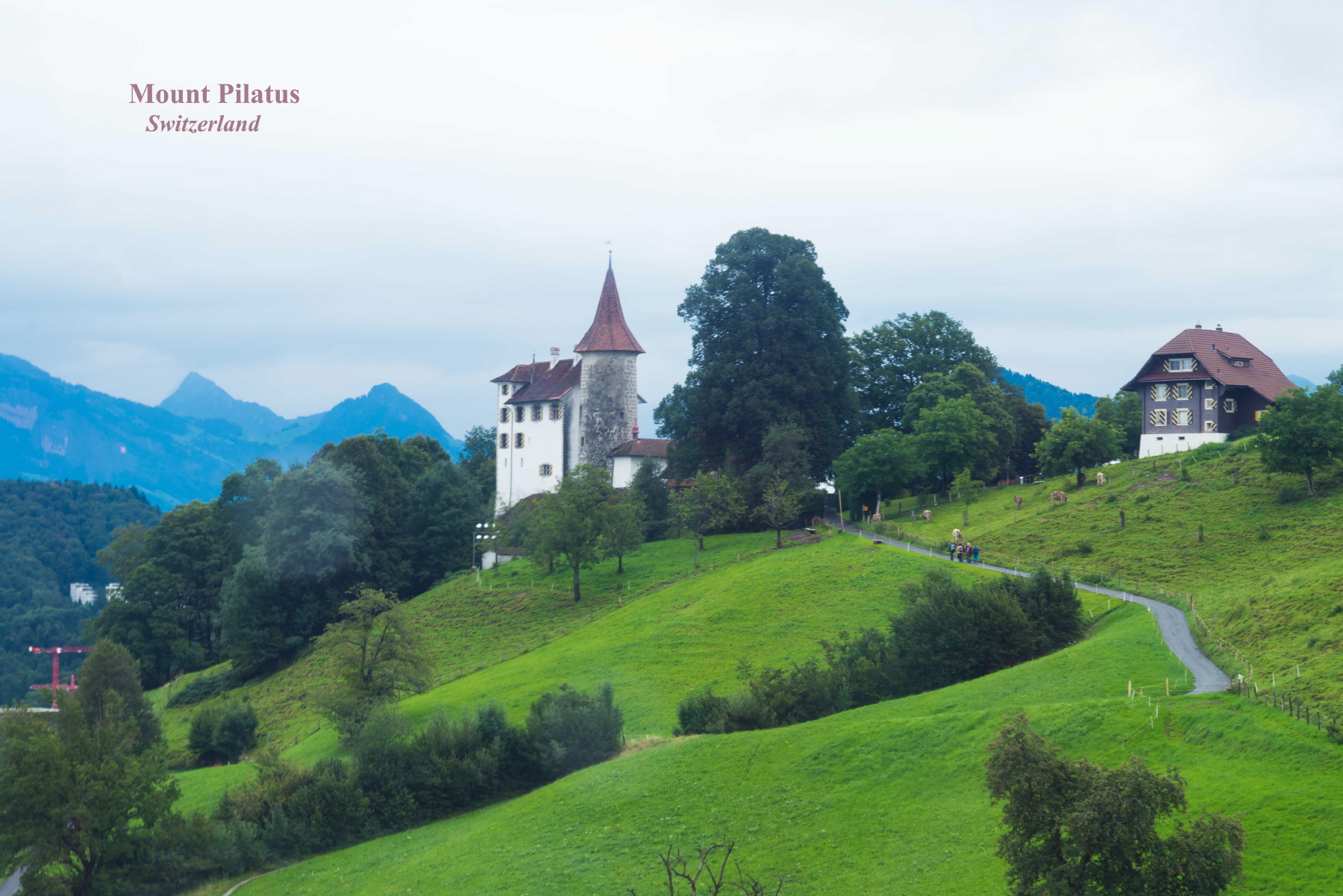
Our first destination today was Mount Pilatus–a mountain that rises 6,981 feet. From the gondola we took to the summit we had glorious views of the mountain. Below we could see hikers, coniferous trees, cows (with bells) and numerous varieties of wild flowers. For a flower child like me, it was very difficult not to spend all my time there. I would love to hike it some day. Perhaps when I am not so old. To get down the mountain again we took a cogwheel train

The ride on the cogwheel train is amazing. The cogwheel train that we took down the mountain was incredibly steep. Apparently it drove down at 48° at some points. I wish I could have seen that from the outside. From inside the rail car it is not easy to see.

When we got down to the bottom of the mountain we got back on our coach and drove along the Lake of the 4 Cantons to Luzern. I really think the city centre is one of the most beautiful in Europe. Chris to my disappointment was not quite as enamoured of it as I was.


I think that Luzern is one of the great cities of Europe. Mark Twain was in my camp. He thought that when he visited Luzern in 1878 that he had found a place of enchantment. He loved the way the town “scrambles up and spreads itself over two or three hills in a crowded, disorderly, but picturesque way.” I love disorderly and picturesque. Crowded not so much.


I have been told that Luzern has not changed that much from 1878. It does have a stunning combination of a romantic city set in lovely mountains. There was magnificent beauty to be found here. One only had to look around the tourists. I think it is one of the most beautiful city centres I have ever seen. The old buildings, bridges and churches were stunning.

A highlight was, of course, the ancient bridge called Kapellbrücke with Wasserturm. This is an outstanding feature of this sparkling city. It is a wooden bridge that stretches more than 660 feet long on stilts over the River Reuss.

Luzern has a strong claim to civilization. Its magnificent preservation of history is powerful evidence to support its claim. It likes to be considered the ‘City of Music.” If that is true it is truly civilized. Music is certainly one of the important markers of a civilized society. The city refers to itself as a city of festivals throughout the year.


The Hapsburgs purchased the town (how do you purchase towns?) in 1291 from the owner of the town Murbach Abbey in Alsace. In 1332 Luzern joined the Swiss Confederation. The people of Luzern were not always enamoured of their Hapsburg “owners.” In 1386 they were so unhappy with the Hapsburgs that they won their freedom in the Battle of Sempach. After the Protestant Reformation in the 16th century Luzern became a Catholic of the Counter -Reformation challenging the Protestants.

Near the end of our walk we encountered a loud group of boisterous marching young men banging drums and shouting incomprehensibly. It looked like the revolution had begun. We wondered if this was a political group protesting an injustice or a soccer team celebrating their own greatness. Soon we realized it was the latter. While we were glad to be safe, we were sorry to have missed out on history. As I have always said, “Start the revolution without me.” I will join later—when its safe.

Our walk was pitifully short for such a wonderful place, but is one of the hazards of travel. Good things are of too short a duration; pain last interminably. Too soon we were herded back into our coaches to continue our journey. Everything led to the ship.

In Basel we moved in to our Riverboat Imagery II operated by Avalon. We loved the ship. We particularly loved the large open windows that in effect made the entire cabin a balcony. We had been “sold” on this in Canada but were a bit sceptical that it would work. It worked wonderfully. The best things on the ship though were outstanding food, copious amounts of wine or beer served with meals, and the amazing group of friends that we made.

After we checked in with front desk we went directly to the bar without passing go. Chris had a Jameson and I had dark rum. This was a start of things to come. Frankly, and I must tell the truth in the chronicles, no matter how scurrilous that truth is, on this trip we drank too much. Part of the problem was the many good friends we made on this trip. My mother always said that I was a very nice boy but bad associates were leading me astray. I have always agreed with this unbiased assessment.


August 11, 2017 Zurich

August 11, 2017 Zurich, Switzerland—Where beer and wine are as cheap as water

Today, we took a half-day city tour by coach. Most of the buildings in Zürich were built in the 19th century and that was exactly the time I was reading about in my Hobsbawm book—The Age of Capital—so I appreciated that. It is a 1 in a series of 4 books on European history since the French Revolution. I loved that book for it had insights on every page. I find a book like that adds immeasurably to travel.
Zürich has one of the best and most used public transportion systems in the world even though it is about half the size of Winnipeg. And it worked marvelously well.
Public transportation is extremely popular in the city. About 70% of the visitors to the city use it as we did today. About 50% of all journeys in the city are taken on the public transportation system. That is among the densest usage in the world.
Logically, in my opinion, the people prefer to travel by train or bus. Who wouldn’t? Really you would be stupid if you did not use it. It was that good. Residents of Zürich are not as enamoured of private vehicles as we North Americans are. Zürich train station is the busiest train station in the world!
We stopped to take a photograph of Lake Zürich but really we were not that impressed. The lake is nice, but not really anything special. Our guide said that the water from the lake is drinkable. Why then, we wondered, do so many people drink bottled water in Zürich? Of course, I wonder that about most cities. I wonder about that back home too.
We drove by the University of Zürich, which is home to 26,000 students. A sign of respect that the country gives to education is seen in the fact that every University student is given a free pass for the public transportation system. That is perhaps why it has had 21 Nobel Prize winners. Compare that to Canada which has a population nearly 4 times as high, but it has had 22 Nobel Prize winners–only 1 more. And of Canada’s winners, one was Saul Bellow who was born in Canada but spent most of his life in the United States. I would call him more of an American Nobel winner than Canadian winner.
As our guide pointed out Zürich benefits from the fact that its citizenry is very educated. I believe that this is true, even though neo-liberals don’t see it. Having an educated public was instrumental in Zürich attracting substantial business from Google. Corporations like more things than low taxes. I don’t deny that low taxes are attractive to businesses, but they are by no means their only concern when deciding where to start a business.
Zürich has been an intellectual centre for more than a century. Many famous intellectuals have lived and worked hear such as Lenin, Einstein, Le Corbusier, Jean-Luc Godard, Daniel Bernoulli, Jean-Jacques Rousseau, Carl Jung, Elizabeth Kübler-Ross, and Napoleon III. That is a pretty impressive line-up for a city much smaller than Winnipeg.
It is my belief that education and respect for knowledge has played an important role in making the Swiss happy. That might sound funny. Most people don’t associate school with happiness. Switzerland is consistently voted one of the best (if not the best) places in the world to live. Switzerland was ranked No. 1 in the world’s happiest countries in the world in 2015 and came in second in 2016, after Denmark, out of 156 countries. Even though their society, as we learned is far from perfect, we have a lot to learn from the Swiss.

001-Grossmunster-Church--1.jpg
Zürich has 3 old and famous churches. The oldest is Grossmünster (Great Minster) Church. According to legend, Holy Roman Emperor Charlemagne started construction around 1100 more than 900 years ago. That was 400 years before Columbus “discovered” North America on behalf of Europeans.
Kenneth Clark said that the hallmark of civilization is the desire to create something that lasts. If that is a valid comment, and I believe it is, then this is certainly part of Western civilization–an important part of civilization.


003-Fraumunster-Church-1
The next church we marveled at was Fraumünster Church. This church was a former abbey for aristocratic women from southern Germany that was founded in 853 by Louis the German for his daughter Hildegard. The first church was built before 874 but not the current church on the same site.
The third church we saw was St. Peter church that was built on the remains of former churches at the same site since before the 9th century A.D. That makes it pretty old too. It also has the largest clock face in Europe. The clock was built in 1538. Think about that. The clock has been operating since 1538 about the time that Jacques Cartier and his crew was exploring Canada as the first European explorers to do so and that clock is still working!
At the hotel we discovered that wine and beer were as “cheap” as water. Of course a bottle of water cost about $10. Hardly cheap. That same bottle of water in the Train station store cost less 85 cents! Beer too was about the same as a bottle of water. Have I arrived in paradise where beer is cheaper than water?

August 10, 2017 Zurich

Today after a brief nap to try to recover from jet lag,  we explored our hotel. It is called Mővenpick Zurich Airport. We quickly realized that we could not eat in our hotel. Food was too expensive. At the restaurant in our hotel a burger and fries cost 26 Swiss Francs. That is about $45! So we had a choice–bankruptcy or starvation. After a short huddle to consider those options we settled on bankruptcy. That appeared more attractive, because it takes a while to suffer the consequence of profligate spending. Starvation happens much fast. In lieu of pending financial ruin we want to warn all of our many friends to dig deep to help us out.

We basically stayed close to the hotel because we were too tired to do much. It was also gray and rainy. So we had little appetite for exploring the city today. We had plain run out of gas as a result of out grueling flight. Being wedged into a tiny seat without sleep is just hard. I went to sleep at 8 p.m. because I could not stay awake any longer. I really did not want to go to bed that early but frankly had no choice.