The Lorax


My granddaughters, Emma and Nasya came over for the night. It was a sleepover. They wanted to play in the hot tub, play pool, and watch a movie. We did all of that. I offered to watch a movie with them, intending to read as they watched, but they tricked me. Nasya insisted that we keep the lights out so she could watch it better. But I tricked her; I watched the movie they had chosen and loved it. That was much to my surprise.

The movie we watched is called The Lorax. It is an animated film based on a story by Dr. Seuss. The forest dwelling Lorax wants to save the shortsighted Once-ler who is trying to get rich by cutting down every tree in the forest. He replaces the trees with fake trees that he thinks are better and that help him make a profit.

Once-ler, being a good capitalist, tried to make as much profit as he can so he tried to sell Theneeds. I think the reference is to needs. He manufactures needs. He induces people to want what he can sell. Is that not capitalism at its finest?

Of course, that leads to environmental degradation as air quality deteriorates and there is nothing left to create more air. Yet the people can’t stop until they have cut down the last real tree.

The Once-ler also considers putting air in a plastic container to sell to the people who no longer have clean air to breathe. A critic asks, “Do you think people will be stupid enough to pay for air in a plastic bottle when they can get it for free?” The answer, of course, is obvious, that is exactly what people do with water isn’t it? They certainly are stupid enough.

I was surprised to see how seriously Emma took to the film. She had a very hard time when the trees were cut down. I tried to reassure that things would get better. And they did. As in most kids’ movies, good triumphed in the end. “Thank goodness for good.” That was another line from the movie. Perhaps it was the theme.

Throughout the film, outside the home of the Lorax, is a rock labelled “Unless.” At the end we learn this is from a quotation by Dr. Seuss. “Unless someone like you cares an awful lot, nothing is going to get better.” That should be the motto for the environmental movement.

I hope my grand daughters learned something today. I think they did. I know I did.

Two for Texas

Two for Texas by James Lee Burke


James Lee Burke is one of my favorite writers. Until now, nearly all of his books which I have read were detective novels. The only exception was a short story collection. The latest book of his that I have read was also out of the ordinary for Burke.

This book is a work of historical fiction. By that I mean it takes place in a specific time and place. In this book that was the so-called revolution of Texas in 1835 to 1836. Secondary characters in the novel include Sam Houston, Jim Bowie, and Davy Crocket.

I was struck by the similarity of this book to the best American novel, The Adventurers of Huckleberry Finn. Both novels are about 2 males making a burst for freedom. In Two for Texas, the two protagonists escape prison after killing their prison guard. The guard was not a sympathetic figure, yet I found his murder shocking. The good guys don’t often commit murder. Here they did.

The book is a classic about freedom and the refusal to buckle under to tyranny. First the tyranny of the French prison is resisted. Then the tyranny of the Mexican soldiers.

The revolutionary war leads to massive violence and death. At the end the violence is over, but there is no clear sense of redemption. Here is how With his typical mastery of metaphor and imagery Burke describes the end of the battle through the instrument of an image of a young boy, Son Holland, greedily drinking water from a canteen. He call is this way,


Son pulled the wood plug from the canteen and drank until the water poured down from his lips.

“You drink like that was whiskey,” the soldier said.

The water ran down his chin and neck and over his dusty chest, and as he lifted the canteen higher he thought he could see the whole landscape, the breastworks, the blackened crater where the Mexican cannon had been, the ground strewn with dead men and horses, the violent green of the trees in the distance tilt upward into the shimmering sky, as though it all were being pulled over the earth’s edge.


I particularly took note of the “violent green of the trees.” There is no idyllic regeneration here, often symbolized by the colour green. There is no comfort to be had. Son, a young boy, has been throw a violent battle, but perhaps he too has been “pulled over the earth’s edge.”

When Son Holland and his partner, the much older wizened and sprinkled with cynicism Hugh Allison and the Tonkawa woman Sana leave the territory by crossing the Red River, Burke describes the scene this way,


The sky was so blue and hard that it looked like it would crack if a rifle ball were fired against it.


The war is over. At least until the next one. And there is no reconciliation. There is only the enduring stubbornness of men and women.

Growing Up with Vietnam


I grew up with the War in Vietnam. Some of that personal history I am not proud of. My only defence is youth and ignorance. Not a strong defence perhaps, but it’s the best I’ve got and as I’ve learned many times–you gotta go home with the girl you brung.

When I was young I was a devoted follower of Ayn Rand. Today I blush at the thought. Again I rely on my only defences–youth and ignorance. As a follower of Ayn Rand I was required to be an enemy of international Communism. It stood for the death of personal freedom and imposition of dreaded socialism.

As a result of these fundamental principles I had a ready answer to anyone who wanted to talk about the war in Vietnam. The US was on a holy mission to eradicate Communism and halt the spread of this vile contagion. I really believed that stuff.

In fact as a young grade 12 student I had an opportunity to enter a public speaking contest. The top prize was $40. That was not chump change in those days. I could use that money to support my bad habits: pool and cigarettes. I learned very few had entered and my chances were good. In fact I won the prize

I picked as my topic, the war in Vietnam. I chose to explain to the masses how Communists were bent on world domination and had to be stopped or they would take over Southeast Asia and from there, the world. I accepted the domino theory.

Eventually I learned better. I would say I got older and smarter. Some might disagree about the latter. Early on in my first year of University I started to learn more about the world and what the Americans had been trying to persuade. My views changed completely. Soon I was opposed to the War in Vietnam and could not understand any more how I could ever have thought otherwise.

My views changed in part because of a book by a new hero–Bertrand Russell. The book was called War Crimes in Vietnam. The issue of the war burned hotly on university campuses around the world in 1967, when I first attended the University of Manitoba. There were numerous educational talks and rallies in support of the war and in opposition. It was the issue for college students of my generation, for a while. I learned a lot and I learned it fast.

Many students supported the Americans in the war for reasons similar to the ones the motivated me. However a growing number of students were beginning to realize that this war made no sense. It was unlikely to be successful, but much more importantly it was morally wrong. The Americans did not belong I Vietnam and we should not support them and in fact we should try to encourage them to give it up.

I joined the opposition to the war early on in my first year. Now I would say, it did not take long for me to come to my senses.

Eventually the Americans abandoned the war, but not before nearly 59,000 Americans had died, and more than a million Vietnamese people. And all those lives were sacrificed for nothing. The deaths were futile. I felt sorry for the men and women who died on both sides of the war. It was a horrible waste. It was a permanent stain on the United States of America.

Years later I read another book this time by Barbara Tuchman called The March of Folly. One of the follies she described so well was the folly of America in Vietnam and how America had betrayed itself there. I agreed wholeheartedly.

Now, in 2017, there is a PBS film limited series produced by Ken Burns and Lynn Novick called The Vietnam War. It is showing each night on PBS as I write this and I have only seen half of it, but I am enthralled. It tells about the war in great depth. More importantly it tells about the war with video, photographs, learned opinions, and most importantly interviews with people involved on both sides of the war–Americans as well as North and South Vietnamese people. It is outstanding television. I strongly recommend it to everyone. To me, it is woken me from my slumber. I intend to comment on aspects of it in this blog.

Going in Style


I watched a comedy movie recently in an aircraft on a trans-Atlantic flight when the lights went out and I could not continue reading my book. The movie was called Going in Style.The movie establishes 3 old codgers (can codgers ever be young?) Joe (Michael Caine), Willie (Morgan Freeman), and Albert (Alan Arkin) who retired after working for a company for 40 years only to find that the company has outsourced its work out of the country, merged with another company, and dissolved their pension. Instead of paying their loyal employees they are using the pension money to pay utility bills. All of this financial chicanery was financed by their very own bank. Sounds pretty dastardly and I wonder if that can be done so effortlessly in the US. I sure hope not.

The 3 codgers are naturally upset at how they have been robbed by corporate America. That sounds reasonable enough. But their solution is radical, if not revolutionary. They decide to the rob the bank to get their money back, vowing not to steal any more than needed and if they accidentally take too much will give the excess to charity.

Joe, the leader of this geriatric rat pack, has in fact suffered a double whammy of corporate shenanigans. As if losing his pension was not bad enough a smarmy banker persuaded him to take out an adjustable mortgage that had a very large uptake of interest that he had been assured was extremely unlikely. Now he was unable to pay and the bank was taking legal action to evict him out of his home. All of this rings fairly true and clearly ought not to countenanced by any political system in which electors were not scandalously tied to corporate fraudsters, but this movie does not go too deeply into the revolutionary possibility of working class reactions. After all the movie is a comedy not a left wing tract.

Much of this sounds a bit like Woody Guthrie’s classic Pretty Boy Floyd. Here are some of the lyrics about that bank robber who was a bit like Robin Hood:


But a many a starving farmer

The same old story told

How the outlaw paid their mortgage

And saved their little homes.


Others tell you ’bout a stranger

That come to beg a meal,

Underneath his napkin

Left a thousand dollar bill.


It was in Oklahoma City,

It was on a Christmas Day,

There was a whole car load of groceries

Come with a note to say:


Well, you say that I’m an outlaw,

You say that I’m a thief.

Here’s a Christmas dinner

For the families on relief.


Yes, as through this world I’ve wandered

I’ve seen lots of funny men;

Some will rob you with a six-gun,

And some with a fountain pen.


And as through your life you travel,

Yes, as through your life you roam,

You won’t never see an outlaw

Drive a family from their home.


There is another political element to the film. Joe got his inspiration for the bank robbery from an actual robbery of his bank where he was an innocent spectator. One of the robbers refuses to steal from Joe. Instead, he says, “It is the duty of every culture to help its elders.” That too rings true, but is, as we all know, radically ignored in modern capitalistic society. We do a very poor job of fulfilling our “duty.”

Of course most countries do a much better job of taking care of seniors than the United States. The current Republican Senate and House of Representatives is much more keen on giving tax breaks to the rich than helping poor seniors or any other people for that matter.

I won’t say Going in Style is the best movie. It is not even a great movie. It is however mildly entertaining and the 3 leading men and Anne Margaret as the spicy love interest for one of the codgers all bring years of experience and professional skills to their task. If, like me, you find yourself in a dark aircraft, unable to read a book, it is worth the view.


August 14, 2017 Strasbourg and Alsace France: I love wine

We woke up in France. Part of the Rhine River travels through the border between France and Germany. That is where we were. This part of Europe has of course been actively fought over by France and Germany many times through the centuries.

This was our first time in France; we were absolutely thrilled. We have travelled a fair bit, but never to France. Today we tried to make up for that. We think we did.

Our guide for the morning was Florian a handsome young student who was free with his knowledge and opinions. Some of our group were not impressed. Most of us thought he was a fantastic guide. Chris and I were enthusiastically in the second camp. He had a lot of knowledge of European art in particular and obviously loved to share it.

Because the region and the city have changed so often, (5 times between 1870 and 1945) it is difficult to say whether the residents are French or German. The dialect that Florian spoke, even though he is a citizen of France, is 70% German and 30% French.


026-Strasbourg-France--1

We took a short bus trip to a smaller boat so that we could sail through the canals of Strasbourg. To our disappointment, the smaller boat was covered with a glass roof. That did allow us to see the city, but it made photography all but impossible. According to Florian, when it got hot this created a greenhouse heat.

Europeans are strange. In 1977 the Palais de l’Europe in Strasbourg was completed becoming one of the 4 capitals of the European Union. Who would want 4 capitals? The cost of course is crazy, but Europe can afford it. Strasbourg is not the capital of France but is a capital of Europe. It acts as the capital for only 4 days each month. As a result there are a number of international institutions in the city. Right beside it is the European Parliament and the European Court of Justice as well as the European Council.

One of the interesting things about Strasbourg is that it is formally secular. The people still resent the profound effects of the 30 Years War. That war resulted in the loss of 1/3 to ½ of the population. After such a war they were reluctant to allow religious disagreements to become part of state policy. In fact much of France is keen on secularity in politics. Who can blame them for that?

Interestingly though, according to Florian, one can still be sued for blasphemy, though the law is ignored to such an extent it is no longer effective. Sort of like marijuana laws in the Netherlands.

According to Florian, Strasbourg is now a city of many religions. They even have Mennonites and Amish. This may not be surprising, since the Mennonites are taking over the world by stealth. If you don’t believe that read the Daily Bonnet. The site is for Mennonites sort of like Pravda for Russians. At the start of our journey into the city, a new Russian Orthodox Church was under construction. Thanks to the European Union diverse groups have been emigrating to France. For example, 7.5% of France is now Muslim and that is not without controversy of course. Of course with diversity, come challenges.

The historic centre called Grande Íle (Grand Island) was classified as a World Heritage site by UNESCO in 1988. It was the first time that an entire city was so designated.

Some famous people have lived here including John Calvin, Albert Schweitzer, and Johannes Gutenberg.

The French Constitution of 1958 provides that France is a democratic, secular country, but religion in France is never that simple. That constitution makes France constitutionally secular with churches and state separated. Even though it says that the government does not recognize or subsidize any religion the taxpayers of France in fact subsidize religion in many ways. For example, the law provides that for public funding of religious education the Catholic Church is the primary beneficiary of that law, but not the only beneficiary.

The European Union is an interesting experiment. They have created an economic union, but not really a political union. Some people in some countries think the central European government has been overly aggressive in imposing centralist policies that the rural people in particular resent.       One of the wonders of the European Union is the reconciliation between France and Germany that it has facilitated. I remember one of my fellow travelers in Africa who was a German resident filled with pride that these former enemies–France and Germany–were now friends. That is a remarkable achievement when you think about how often they have gone to war. I hope it lasts.

Part of the problem between these 2 countries was the Treaty of Versailles after the First World War. Germany was never successfully invaded in that war. It was not really defeated militarily. The impositions on Germany after that war were hugely unfair and led directly and quickly to the rise of a German populist leader–Adolf Hitler. Germans revolted against this injustice and listened to a rabble-rousing leader who in effect promised to make Germany great again.


027-Strasbourg-Cathedral--1

We eventually got off the boat for a walk through part of the town. Then we saw up close one of the highlights of Strasbourg–the Cathedral (Munster) of Strasbourg. This was the tallest building in Europe for nearly 5 centuries. It is 461 ft. high and contains some remarkable features. Unfortunately, we could not get a view of it from a distance as we could in Breisach. It was completely surrounded by buildings, as was the Duomo in Florence. As a result of course, we got no good photographs of this magnificent church. That is a pity.

028 Strasbourg stained glass with name


030-Imaggery-II-Strasbourg-Cathedral--1

After a short stroll through the old city, we met again and Florian led us back to the boat where we enjoyed a light barbecue lunch on the upper deck. We overheard ignorant Americans at the next table say they did not like France because “we have rescued it too many times.” More self-satisfied nonsense from Americans. When will it ever end?

031-Exotic-flowers-of-Alsace-1

I always have difficulty passing up flowers wild or exotic

In the afternoon, we had another guide who took us in a bus to Alsace. It is cultural and historical region of eastern France located on the eastern border of France and Germany.

Alsace is a great wine-producing region. Grape growers believe that grapes must suffer to be worthy of good wines. The grapes have to get thirsty. If life is too easy, the grapes produce inferior wines. It reminds me of my belief that suffering is needed to produce religious enlightenment. Added to that, the soil cannot be too rich. Poor soil is better than rich soil for wine production. This forces the roots to grow deeper and grow through a variety of soils. The diversity of the soil is good for complexity of the wine.

Our tour took us to a small family vineyard and winery in the town of Obernai. It has been owned by the Robert Blanck family since 1732! During the centuries the knowledge about wines and grapes has been passed down through the generations. We were introduced to the wine production by one of the daughters of the owner. She was very knowledgeable about grapes, wines, and wine production. We learned an amazing amount about wines. Sadly, we also forgot a lot about wines.

Grape growers do not allow the leaves of the grape vine to touch the ground. Added to that, the Alsace producers do not allow any winery to add sugar to the grapes. It must be pure to qualify as Alsace wine. They also do not permit any blends.

We also learned that climate change is having a big effect on grape growing. Because growing seasons are changing, the wine producers sometimes have to cool down the grapes that have been harvested because often the warmer weather starts fermentation too soon for best quality. I was pleased to see that the Americans at our table did not cover their ears when this was explained, but I am not sure about other tables.

We loved all the wines we sampled (4 of them). Well at least I loved all 4 of them. The ladies beside me did not agree. They did not enjoy some of the wines. This was a great pity, for when they did not enjoy a wine they poured it into my glass rather than the trash container we were given. As a gentleman I had no choice but to help the ladies out. I must always rescue damsels in distress. Sadly that meant that I consumed too much wine. What a pity! My mother always said that I was a very good boy, but bad associates could get me into trouble. That is exactly what happened today.

032-Obernai-Alsace-1

After we left the winery we drove back to our ship. We started driving through the town of Obernai. It is a gorgeous old town and would have been worth a stroll, but sadly, we had no time for a stroll. Our taskmaster guide forced us to leave. It was nice to see a stork on a roof top.

Back on the ship we were “entertained” by a group of French musicians who had supposedly just come from Vegas. I told our companions, Scott and Susan from Delaware/New Jersey and Fort Lauderdale respectively, that I considered the accordion an instrument of torture.

We dined with Scott and Sue later and found out that Sue was a Trump supporter and her son Scott hated Trump. That made for some interesting conversations. Sue tried to convince us that Trump had done some good things, but unsurprisingly, she had a difficult time finding some examples.

Dinner was another elegant and tasty treat. The more wine Scott consumed, as his mother pointed out, the more of a raconteur Scott became. We didn’t mind; we had a marvelous time.


August 13, 2017 Breisach Germany to Strasbourg France: Often little gems are the best

Much to my distaste, I woke up much too early. The causes were probably over excitement. I always have trouble sleeping the first night of a vacation. This is particularly true when I am recovering from jet lag and under the influence of strong drink. I woke up at 4 a.m. After that I took a long shower and wandered off to the early bird riser breakfast. This is a small breakfast offered at 6 a.m. to those fools who don’t know how to sleep properly.

After our breakfast we went on our first and worst excursion. This was a long bus ride to the Black Forest. We also noticed a number of vibrant corn fields as well as fields of flowers. Germans love their blumen (flowers). And who could blame them for that? Not I. As from commercially grown flowers in the farmers’ fields, there were numerous wild flowers throughout the country. This surprised me as I expected Germany to be too civilized for wild flowers. That means there is still hope for the rest of us.

Our destination today was a small village where we stopped at a store that produced and sold cuckoo clocks. For me this was not a highlight of our trip. I hate cuckoo clocks. Who would want a clock that makes an infernal noise every hour? Not me.

I really thought this was a lame excursion. We drove 1 &1/2 hours by bus and then the same distance on the same route back again, and made one photo stop. I know that photography is not the sole criterion for a good excursion but it is certainly one of them for me and, I believe, others as well judged by the number of people that rapidly exit the coach when we did stop. I felt we had spent 3 hours in a bus for very little. I could have done better–much better–by staying in Breisach. I was not mad at anyone. We had chosen this excursion, why I am not sure. I think it was included in the price. So being a cheap Mennonite got me into trouble again.

We saw our first castle as we were driving through the Black Forest. This was a very modest castle, by Rhine River standards, but it was nice to see. It gave us a foretaste of what we would see later. This castle was a ruin from the Thirty Years War. That war had a devastating impact on Germany.

It was waged from 1618 to 1648 and was the deadliest religious war in history. About 8 million people died in that war(s). The war started as a war between various Protestant and Catholic states in the fragmented Holy Roman Empire in central Europe. Eventually most of the great powers got involved in the action. When the states got involved the war was less about religion than it was about politics. Just like the Irish Troubles. It really was the continuation of rivalry between the French and the Hapsburgs for European domination.

The states used large mercenary armies to fight their foes. Before the war there was relative peace that had been established by the Peace of Augsburg that allowed Catholic or Lutheran (but of course not Calvinists) to determine the religion of their subjects. There was little or no thought given to allowing the individual peasants to choose for themselves. Why would that be necessary? After all, they were peasants. When it comes to religion there is always someone who thinks that his or her views on religion must be imposed on others. Sadly, that tendency is alive and well today. Thank goodness today the religions have a lot less authority than they used to have.

As so often happens in wars, the 30 Years’ War devastated the entire region. Everyone suffered. That is usually how wars work, though that lesson is often ignored or forgotten by belligerents. War also produced famine and disease common consequences of wars. As a result casualties were high. The war also bankrupted most of the combative powers. Isn’t war glorious? As always, of course, the people suffered. That is what wars do; wars cause common people to suffer enormously while princes wail.

Our destination today was a small village where we stopped at a store that produced and sold cuckoo clocks. For me this was not a highlight of our trip. I hate cuckoo clocks. Who would want a clock that makes an infernal noise every hour? Not me.

I really thought this was a lame excursion. We drove 1 &1/2 hours by bus and then the same distance on the same route back again, and made one photo stop. I know that photography is not the sole criterion for a good excursion but it is certainly one of them for me and, I believe, others as well judged by the number of people that rapidly exit the coach when we did stop. I felt we had spent 3 hours in a bus for very little. I could have done better–much better–by staying in Breisach. I was not mad at anyone. We had chosen this excursion, why I am not sure. I think it was included in the price. So being a cheap Mennonite got me into trouble again.


After lunch we did what we should have done in the morning. We had a most pleasant walk through Breisach. This is a lovely little village. We had caught a glimpse of it from the ship on our way in, but we did not realize the beauty for the village until we strolled through it. To begin with, it was a marvelous afternoon. Bright and sunny. Warm and pleasant. There were surprisingly many people strolling through town. We gathered they were both locals and tourists on a fine Sunday afternoon.


Yesterday our Cruise Director joked that probably most of us signed up for this cruise because we wanted to see Breisach.  Of course very few of us had ever likely heard of Breisach. it is a tiny town. yet, I came to realize the Director was right. Breisach was exactly what I wanted to see. It was a lovely little town with interesting things to see and photograph. We loved sitting outside sipping a beer (me) and a wine (Chris) soaking up the sun and atmosphere. As is so often the case, the little gems of travel are the best. The things we are expected to enjoy (like the Black Forest) sometimes disappoint.

I particularly enjoy photographing the churches and cathedrals of Europe.  This is particularly true when they are perched on top of a hill and I am able to get far enough away to capture it digitally. This was a great day.

August 12, 2017 Zurich Switzerland to Luzern Switzerland to Breisach Germany

In Switzerland politicians are not idolized and people don’t exaggerate their importance either to do good, or do bad. Americans and Canadians could learn from the Swizz. The people elect 220 members of the Assembly who in turn elect the Ministers. That is sort of like Canada. The members of the Assembly also elect the President. With a system like that no one makes a big deal about who the President is. It really does not matter that much. One of the things that our tour leader said I found most interesting. She said that many people in Switzerland do not know who their current President is. I think that is cool and a good sign of a healthy democracy.

Swiss independence was recognized in 1648 during the Treaty of Westphalia that ended the bloody 30 Years War, caused by religious differences that got out of hand. The country is formally neutral, but it is armed. Our tour leader explained that recently the government debated whether or not it should  invest in new fighter jets at a cost of billions. Eventually it decided that it did not make sense to buy jets that could travel right across the country in 6 minutes! Wow, how sensible can you get?


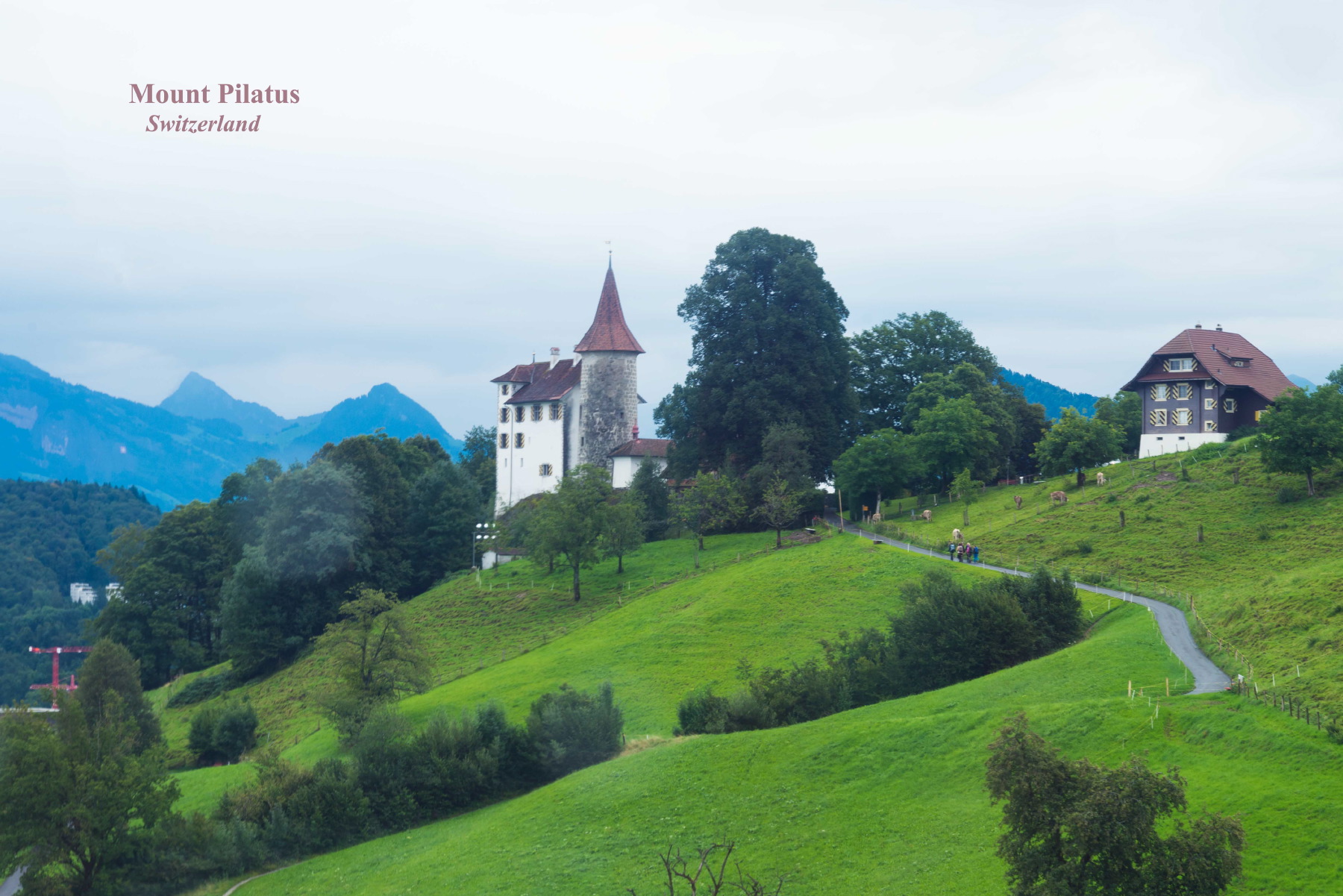
Our first destination today was Mount Pilatus–a mountain that rises 6,981 feet. From the gondola we took to the summit we had glorious views of the mountain. Below we could see hikers, coniferous trees, cows (with bells) and numerous varieties of wild flowers. For a flower child like me, it was very difficult not to spend all my time there. I would love to hike it some day. Perhaps when I am not so old. To get down the mountain again we took a cogwheel train

The ride on the cogwheel train is amazing. The cogwheel train that we took down the mountain was incredibly steep. Apparently it drove down at 48° at some points. I wish I could have seen that from the outside. From inside the rail car it is not easy to see.

When we got down to the bottom of the mountain we got back on our coach and drove along the Lake of the 4 Cantons to Luzern. I really think the city centre is one of the most beautiful in Europe. Chris to my disappointment was not quite as enamoured of it as I was.


I think that Luzern is one of the great cities of Europe. Mark Twain was in my camp. He thought that when he visited Luzern in 1878 that he had found a place of enchantment. He loved the way the town “scrambles up and spreads itself over two or three hills in a crowded, disorderly, but picturesque way.” I love disorderly and picturesque. Crowded not so much.


I have been told that Luzern has not changed that much from 1878. It does have a stunning combination of a romantic city set in lovely mountains. There was magnificent beauty to be found here. One only had to look around the tourists. I think it is one of the most beautiful city centres I have ever seen. The old buildings, bridges and churches were stunning.

A highlight was, of course, the ancient bridge called Kapellbrücke with Wasserturm. This is an outstanding feature of this sparkling city. It is a wooden bridge that stretches more than 660 feet long on stilts over the River Reuss.

Luzern has a strong claim to civilization. Its magnificent preservation of history is powerful evidence to support its claim. It likes to be considered the ‘City of Music.” If that is true it is truly civilized. Music is certainly one of the important markers of a civilized society. The city refers to itself as a city of festivals throughout the year.


The Hapsburgs purchased the town (how do you purchase towns?) in 1291 from the owner of the town Murbach Abbey in Alsace. In 1332 Luzern joined the Swiss Confederation. The people of Luzern were not always enamoured of their Hapsburg “owners.” In 1386 they were so unhappy with the Hapsburgs that they won their freedom in the Battle of Sempach. After the Protestant Reformation in the 16th century Luzern became a Catholic of the Counter -Reformation challenging the Protestants.

Near the end of our walk we encountered a loud group of boisterous marching young men banging drums and shouting incomprehensibly. It looked like the revolution had begun. We wondered if this was a political group protesting an injustice or a soccer team celebrating their own greatness. Soon we realized it was the latter. While we were glad to be safe, we were sorry to have missed out on history. As I have always said, “Start the revolution without me.” I will join later—when its safe.

Our walk was pitifully short for such a wonderful place, but is one of the hazards of travel. Good things are of too short a duration; pain last interminably. Too soon we were herded back into our coaches to continue our journey. Everything led to the ship.

In Basel we moved in to our Riverboat Imagery II operated by Avalon. We loved the ship. We particularly loved the large open windows that in effect made the entire cabin a balcony. We had been “sold” on this in Canada but were a bit sceptical that it would work. It worked wonderfully. The best things on the ship though were outstanding food, copious amounts of wine or beer served with meals, and the amazing group of friends that we made.

After we checked in with front desk we went directly to the bar without passing go. Chris had a Jameson and I had dark rum. This was a start of things to come. Frankly, and I must tell the truth in the chronicles, no matter how scurrilous that truth is, on this trip we drank too much. Part of the problem was the many good friends we made on this trip. My mother always said that I was a very nice boy but bad associates were leading me astray. I have always agreed with this unbiased assessment.


August 11, 2017 Zurich

August 11, 2017 Zurich, Switzerland—Where beer and wine are as cheap as water

Today, we took a half-day city tour by coach. Most of the buildings in Zürich were built in the 19th century and that was exactly the time I was reading about in my Hobsbawm book—The Age of Capital—so I appreciated that. It is a 1 in a series of 4 books on European history since the French Revolution. I loved that book for it had insights on every page. I find a book like that adds immeasurably to travel.
Zürich has one of the best and most used public transportion systems in the world even though it is about half the size of Winnipeg. And it worked marvelously well.
Public transportation is extremely popular in the city. About 70% of the visitors to the city use it as we did today. About 50% of all journeys in the city are taken on the public transportation system. That is among the densest usage in the world.
Logically, in my opinion, the people prefer to travel by train or bus. Who wouldn’t? Really you would be stupid if you did not use it. It was that good. Residents of Zürich are not as enamoured of private vehicles as we North Americans are. Zürich train station is the busiest train station in the world!
We stopped to take a photograph of Lake Zürich but really we were not that impressed. The lake is nice, but not really anything special. Our guide said that the water from the lake is drinkable. Why then, we wondered, do so many people drink bottled water in Zürich? Of course, I wonder that about most cities. I wonder about that back home too.
We drove by the University of Zürich, which is home to 26,000 students. A sign of respect that the country gives to education is seen in the fact that every University student is given a free pass for the public transportation system. That is perhaps why it has had 21 Nobel Prize winners. Compare that to Canada which has a population nearly 4 times as high, but it has had 22 Nobel Prize winners–only 1 more. And of Canada’s winners, one was Saul Bellow who was born in Canada but spent most of his life in the United States. I would call him more of an American Nobel winner than Canadian winner.
As our guide pointed out Zürich benefits from the fact that its citizenry is very educated. I believe that this is true, even though neo-liberals don’t see it. Having an educated public was instrumental in Zürich attracting substantial business from Google. Corporations like more things than low taxes. I don’t deny that low taxes are attractive to businesses, but they are by no means their only concern when deciding where to start a business.
Zürich has been an intellectual centre for more than a century. Many famous intellectuals have lived and worked hear such as Lenin, Einstein, Le Corbusier, Jean-Luc Godard, Daniel Bernoulli, Jean-Jacques Rousseau, Carl Jung, Elizabeth Kübler-Ross, and Napoleon III. That is a pretty impressive line-up for a city much smaller than Winnipeg.
It is my belief that education and respect for knowledge has played an important role in making the Swiss happy. That might sound funny. Most people don’t associate school with happiness. Switzerland is consistently voted one of the best (if not the best) places in the world to live. Switzerland was ranked No. 1 in the world’s happiest countries in the world in 2015 and came in second in 2016, after Denmark, out of 156 countries. Even though their society, as we learned is far from perfect, we have a lot to learn from the Swiss.

001-Grossmunster-Church--1.jpg
Zürich has 3 old and famous churches. The oldest is Grossmünster (Great Minster) Church. According to legend, Holy Roman Emperor Charlemagne started construction around 1100 more than 900 years ago. That was 400 years before Columbus “discovered” North America on behalf of Europeans.
Kenneth Clark said that the hallmark of civilization is the desire to create something that lasts. If that is a valid comment, and I believe it is, then this is certainly part of Western civilization–an important part of civilization.


003-Fraumunster-Church-1
The next church we marveled at was Fraumünster Church. This church was a former abbey for aristocratic women from southern Germany that was founded in 853 by Louis the German for his daughter Hildegard. The first church was built before 874 but not the current church on the same site.
The third church we saw was St. Peter church that was built on the remains of former churches at the same site since before the 9th century A.D. That makes it pretty old too. It also has the largest clock face in Europe. The clock was built in 1538. Think about that. The clock has been operating since 1538 about the time that Jacques Cartier and his crew was exploring Canada as the first European explorers to do so and that clock is still working!
At the hotel we discovered that wine and beer were as “cheap” as water. Of course a bottle of water cost about $10. Hardly cheap. That same bottle of water in the Train station store cost less 85 cents! Beer too was about the same as a bottle of water. Have I arrived in paradise where beer is cheaper than water?